
Budgeting a Small Farm: Turning Daily Payouts Into a Monthly Plan
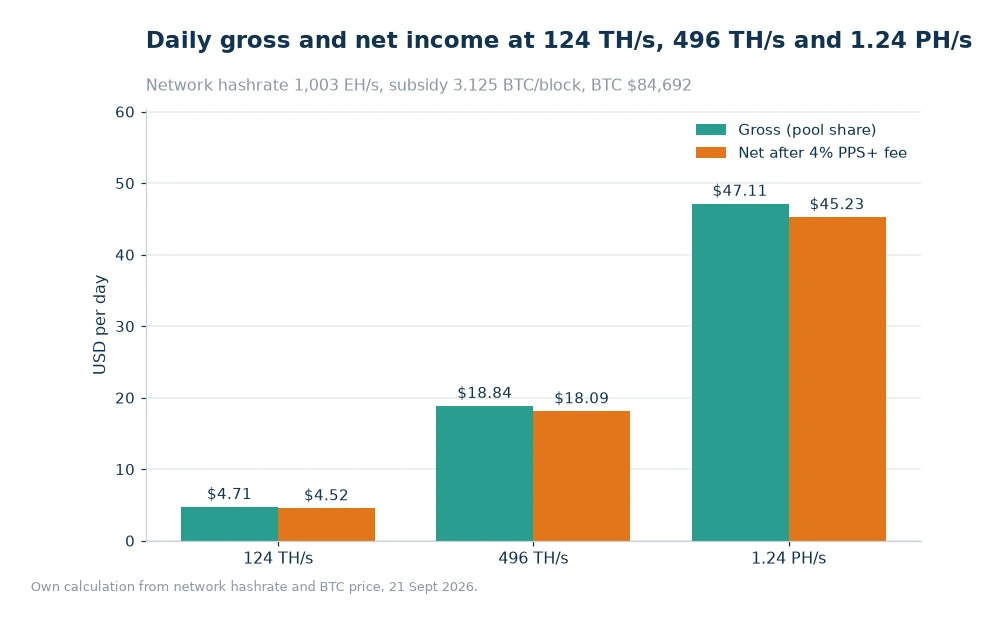
A power bill arrives once a month and a pool balance moves once an hour, and the gap between those two rhythms is where small mining operations get into trouble. At 124 TH/s the schedule returns 5.563e-05 BTC a day, $4.71 at $84,692 per BTC and $4.52 after the listed 4% on the block-reward component, which is $135.60 across thirty days against a bill that does not care how the month started.

Key takeaways
- 124 TH/s nets $4.52 a day, or $135.60 a month, before power and before any difficulty change.
- 496 TH/s nets $18.09 a day and 1.24 PH/s nets $45.23 a day; the scaling is exactly linear.
- Difficulty adjustments land roughly every two weeks, so a monthly plan contains about two revisions.
- Zero-fee mining payouts remove the transfer charge, which makes a weekly sweep to a wallet cheap to run.
Start from a daily number, not a monthly hope
Monthly forecasts in mining fail for a simple reason: they treat a moving input as a constant. Difficulty changes, price changes and uptime changes, and a 30-day projection built on the first of the month is wrong by the fifteenth. A daily number is easier to falsify, and a number you can falsify is a number you can manage.
The daily figure also matches the settlement rhythm. PPS+ credits hourly, so the day is a natural checkpoint: 24 credits, added up, compared with the formula. Under PPLNS the same check works but with more scatter, because blocks arrive unevenly and the last 5 difficulty rounds decide the allocation.
Three dates that shape the month
The first is the difficulty adjustment, which arrives roughly every two weeks and moves revenue per terahash. The current estimate is a 2.12% decline, which would lift output per unit of hash by about 2.17%, and the direction can reverse by the time the adjustment lands. The second is the payout date you choose, either a sweep to a wallet or a conversion. The third is the bill, and it is the only one that is completely inflexible.
Put those three on a calendar and the month organises itself: two revenue revisions, one or more sweeps, one fixed outflow. Most budgeting mistakes happen when a sweep is scheduled after the bill, which forces a sale at whatever price happens to be available on the day rather than at a price chosen in advance.
Holding coin versus converting it
A mining balance is a position in the coin as much as it is a receivable. Leaving it in BTC means the dollar value of the month's work moves with the market after the work is done, which can double the variance of the operation without any change in hashrate. Converting on a schedule removes that extra variance and gives a predictable dollar figure to budget against.
Auto Conversion exists for this exact job: it moves one coin into another on a rule you set rather than on a decision you make at midnight. For a farm paying costs in fiat, the practical version is a recurring sweep of the mined balance into a stable unit, with a fixed share left in BTC. The split is a risk decision, not an arithmetic one, but the schedule should be arithmetic.
Three bands, one month
The table keeps the assumptions visible: network hashrate 1,003 EH/s, subsidy 3.125 BTC per block over 144 blocks, BTC at $84,692, and the listed 4% on the block-reward component as the only deduction.
| Hashrate | BTC per day | Gross per day | Net per day | Net over 30 days |
|---|---|---|---|---|
| 124 TH/s | 0.00005563 | $4.71 | $4.52 | $135.60 |
| 496 TH/s | 0.00022253 | $18.84 | $18.09 | $542.70 |
| 1.24 PH/s | 0.00055627 | $47.11 | $45.23 | $1,356.90 |
Now add the cost side, which the table deliberately leaves out. A 496 TH/s fleet at 20 J/TH draws 9,920 W, or 238.08 kWh a day, which is $14.28 at six cents. Against $18.09 net that leaves $3.81 a day, or $114.30 a month. The revenue column looked comfortable; the margin column is the one that pays the bill.
Worked example
Build the month from the smallest band and check each step against the others.
- Network share: 124 divided by 1,003,000,000 TH/s equals 1.236e-07.
- Daily coins: 1.236e-07 multiplied by 450 BTC equals 5.563e-05 BTC.
- Gross value: 5.563e-05 multiplied by $84,692 equals $4.71.
- Listed fee: 4% of $4.71 is $0.19, leaving $4.52 net.
- Four times the hash at 496 TH/s: 0.00022253 BTC, $18.84 gross, $18.09 net.
- Ten times the hash at 1.24 PH/s: 0.00055627 BTC, $47.11 gross, $1.88 of listed fee, $45.23 net.
- Thirty days at 1.24 PH/s: $1,413.30 gross and $1,356.90 net, which is the figure to hold against the month's power and hosting costs.
- Apply the difficulty estimate: a 2.12% decline raises that month's output by about 2.17%, roughly $29.45, if nothing else moves.
A cash-flow sheet with five rows
Row one: expected daily net in dollars. Row two: expected daily power cost. Row three: the difference, multiplied by the days in the month. Row four: known one-off costs, such as a replacement fan or a hosting invoice. Row five: the buffer carried from last month. The sum of rows three and five minus row four is what the operation contributes this month.
Two rules keep the sheet honest. Update it when difficulty changes rather than at month end, and write the actual figures next to the expected ones so the variance is visible. A sheet that only ever contains forecasts becomes fiction within a quarter.
Keep the fee side explicit as well. The published fee schedule states the listed 4% and 2% rates by component, and putting those two lines in the sheet makes the cost of the payment method concrete instead of abstract. It also prevents the common error of applying a blended percentage to total revenue.
Why one account matters for the routine
The routine above depends on the mined balance, the conversion and the withdrawal being visible together. If they sit in three places, the weekly check turns into a reconciliation exercise, and reconciliation is the first task people drop when they are busy. A single ViaBTC Mining Pool account with a multi-currency wallet behind it keeps the mined coin, the converted balance and the payout history on one screen.
That is an organisational benefit rather than a financial one, and it is worth more than it sounds. Most of the money lost in small mining operations is lost to inattention: a machine offline for a week, a sweep forgotten, a bill paid late from a balance that had already been converted. A boring weekly routine prevents all three.
Frequently asked questions
Should I convert payouts daily or monthly?
Weekly is usually the compromise: frequent enough to remove most price drift from the month's result, infrequent enough that the transfer and accounting overhead stays small.
How much does the listed 4% cost at 1.24 PH/s?
About $1.88 a day on $47.11 of gross income, or $56.40 across thirty days, which is the largest single line item in the fee column.
Does a difficulty decline help a fixed-hashrate farm?
Yes. A 2.12% decline raises output per terahash by roughly 2.17%, so the same machines earn a little more coin until the next adjustment.
Put the first number in the sheet today
Compute your own daily net, subtract your daily power cost, and multiply by the days left in the month. That single line tells you whether the operation is funding itself or being funded from elsewhere. Then set the sweep date a week before the bill and leave it there.
Sources: the published fee and settlement terms[1], with chain inputs read 21 Sept 2026: network hashrate about 1,003 EH/s, difficulty 132.76 T, 3.125 BTC per block over 144 blocks a day, BTC at $84,692, and a next-adjustment estimate of -2.12%. Figures read 21 Sept 2026, published 22 Oct 2026. Power costs use a stated 20 J/TH and $0.06 per kWh.