
Reading a Mining Pool Fee Schedule Line by Line
Most fee schedules are four or five lines long, and no two of them apply to the same money. At 100 TH/s the listed 4% rate on the PPS-settled block reward costs about $0.16 a day, while the listed 2% rate sits on the transaction-fee component, a base that changes with every block the pool finds. Convert each line into dollars per terahash per day before you compare two pools.

Key takeaways
- Two lines, two bases: a listed 4% on the PPS-settled block reward and a listed 2% on the transaction-fee component, never one rate applied to total income.
- Gross output is roughly $0.0404 per TH/s per day, so the 4% line runs at about $0.0016 per TH/s per day — some $4.85 a month at 100 TH/s.
- Difficulty of 132.76 T and a network hashrate near 950.3 EH/s set the gross figure; a BTC price of $85,294 is what turns it into dollars.
- Ask what each rate buys. The 4% line removes pool luck and orphan risk from the block-reward component; the 2% line leaves that variance with the miner.
The component each line attaches to
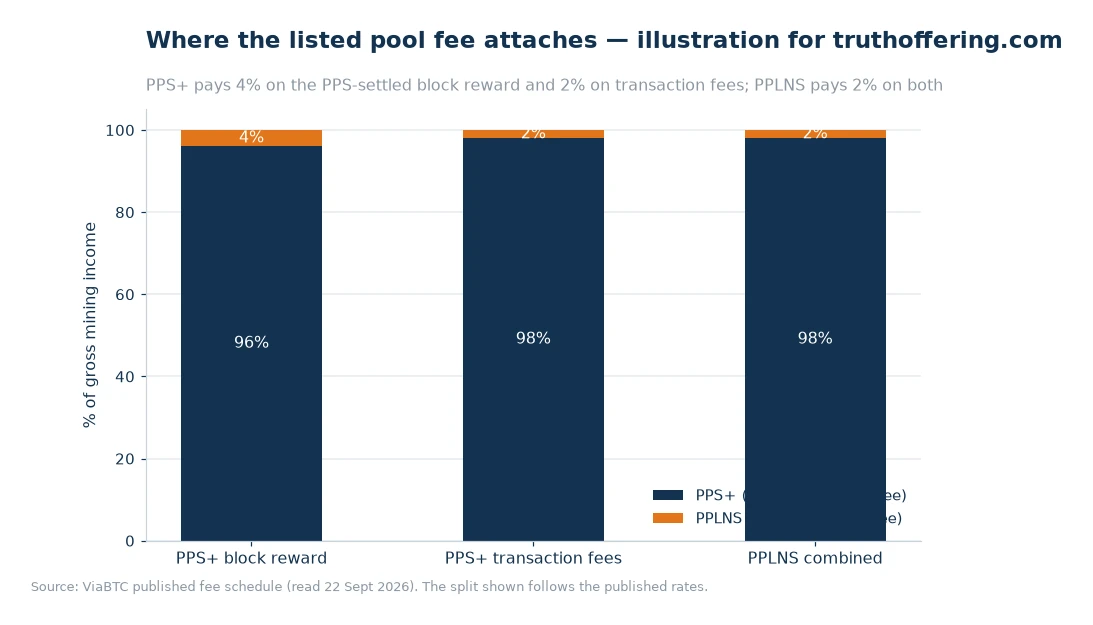
The block-reward component is the predictable half of mining income. Bitcoin issues 3.125 BTC per block, and 144 blocks a day means 450 BTC network-wide, so the base changes only when the subsidy changes. The transaction-fee component is the opposite: whatever the pool's blocks happen to include, which moves from block to block and from hour to hour. A schedule charging 4% on the first base and 2% on the second is charging more where the money is steady and less where it fluctuates, and that is a design choice rather than an accident.
The reason is who carries the variance. Under PPS+ the block-reward share is settled per accepted share at current difficulty and paid every hour, so the miner does not sit through a luck drought or absorb an orphaned block on that component, and the 4% is the price of that arrangement. The transaction-fee component moves through PPLNS logic at a listed 2%. Under PPLNS the two components are merged and one listed 2% rate covers both, distributed after the pool's block reaches six confirmations and weighted over the last five difficulty rounds. Same pool, same machines, different exposure — and a different fee line.
What a percentage becomes in dollars
Start from a single terahash. At difficulty 132.76 T, one TH/s mines about 0.0000004735 BTC a day, which is $0.0404 at $85,294. Four percent of that is $0.0016 per TH/s per day, so the block-reward line costs about $0.048 per TH/s across a 30-day month. An earnings calculator that accepts difficulty, price, the PPS rate and effective hashrate as inputs will reproduce that figure in a few seconds, which is useful when you want to test a second difficulty scenario rather than the current one.
Scale is where the line stops being a rounding error. At 100 TH/s the same rate costs roughly $4.85 a month. At 1 PH/s it comes to about $48.47, and the gap between a 4% and a 2% rate on the block-reward component alone is $24.23 a month. One line of a table, therefore, is worth roughly a hosting plan at that size — which is why the base matters more than the percentage.
| Line in the schedule | Listed rate | Base it attaches to | When it is settled | Cost over 30 days at 100 TH/s | At 1 PH/s |
|---|---|---|---|---|---|
| PPS+ block reward | 4% | Block reward settled per accepted share at current difficulty | Every hour | About $4.85 | About $48.47 |
| PPS+ transaction fees | 2% | Fees included in the blocks the pool finds | With the block | 2% of a base that varies block to block | Same, scaled by fees collected |
| PPLNS combined | 2% | Block reward plus transaction fees together | After 6 confirmations, last 5 difficulty rounds | About $2.42 | About $24.23 |
Read the last column as the size of the decision. At 1 PH/s the difference between the two block-reward lines is $24.23 a month, and at 10 PH/s it is roughly $242 a month. Nothing else in the schedule moves as much for as little effort.
Worked example: 300 TH/s for one month
A 300 TH/s fleet mines 0.00014206 BTC a day at current difficulty. At $85,294 that is $12.12 a day of gross income, or $363.60 across 30 days. The listed 4% line takes $0.4848 of each day, so the daily figure after the fee is about $11.63.
Over the month the arithmetic reads: gross $363.60, block-reward fee $14.54, net $348.90. Electricity is the next line, and it belongs beside this one rather than after it — at 20 J/TH a 300 TH/s fleet draws 6 kW, or 144 kWh a day, which is $8.64 at $0.06/kWh and about $259 a month. That leaves roughly $90 a month before hosting, pool-side payouts and any maintenance, on the numbers above. Raise the tariff to $0.075/kWh and the same fleet pays $324 a month for power, cutting that margin to about $25 — a reminder that the fee line is one row of several and belongs beside the tariff, not on its own.
What the schedule does not say
A rate table answers one question and implies several others. It does not state your uptime, the latency between your machines and the pool, the reject rate, the payout threshold, or how a shortfall gets investigated. Two pools can publish the same 4% and 2% and produce different monthly outcomes for the same hardware, because the schedule is only the part of the arrangement that fits in a table.
The published ViaBTC Pool Fees page is a useful reference point precisely because each rate is written next to the component it applies to, and the settlement rules for both payment methods sit alongside them. Match that against your own numbers with the pool hashrate page open in another tab, and the schedule stops being a marketing line and becomes a cost item you can forecast.
Frequently asked questions
Does the fee apply to my whole income or to one part of it?
To separate parts. Under PPS+ the listed 4% applies to the PPS-settled block reward and the listed 2% applies to the transaction-fee component; under PPLNS one listed 2% rate covers both components together. At 300 TH/s that is $0.48 a day versus the same work charged under the combined rate.
Why would anyone choose the higher rate?
Because the higher rate buys certainty. PPS+ settles hourly at current difficulty, so a run of unlucky blocks does not reduce the block-reward component, while PPLNS payout varies with the pool's luck across the last five difficulty rounds.
How often should the arithmetic be redone?
Whenever difficulty moves or the price moves by enough to change the daily figure, and at least once a month. The next adjustment is estimated at about +1.90%, which changes every per-TH/s number on this page.
Is a lower percentage always cheaper?
No. A lower rate on a wider base can cost more than a higher rate on a narrow one, and a rate that leaves the variance with the miner can mean a lower average payout even though the headline figure looks smaller.
Put the schedule beside your own numbers
Write your hashrate in TH/s, multiply by $0.0404 for gross daily income, then apply each line separately: 4% on the block-reward component and 2% on the fee component for PPS+, or a single 2% on both for PPLNS. Add electricity at your real tariff and hosting at your contracted rate, and you have a monthly figure that survives contact with a difficulty adjustment. Review the sheet when the next adjustment lands, and keep the fee lines as separate rows so a change in one rate never hides inside a blended total.
Data and sources: the ViaBTC published fee schedule, including the listed 4% and 2% rates and the hourly PPS+ settlement rule[1], and the pool hashrate page[2]. Network difficulty of 132.76 T, network hashrate of about 950.3 EH/s, the 3.125 BTC block subsidy and a BTC price of $85,294 were read 22 Sept 2026. All figures are arithmetic on those inputs and move with difficulty and price; they are not a promise of earnings.