
Before You Sign: Capacity and Lead Time Questions for Gift Sets
Comparing perfume factories side by side rarely fails because the numbers are wrong. It fails because the numbers are not measuring the same thing. Capacity can mean batch size, filling speed, decoration throughput or available floor space, and a lead time can start from a sample approval, a purchase order or a component delivery. Get the definitions aligned before you compare, and most of the apparent difference between two quotes disappears.
Key takeaways
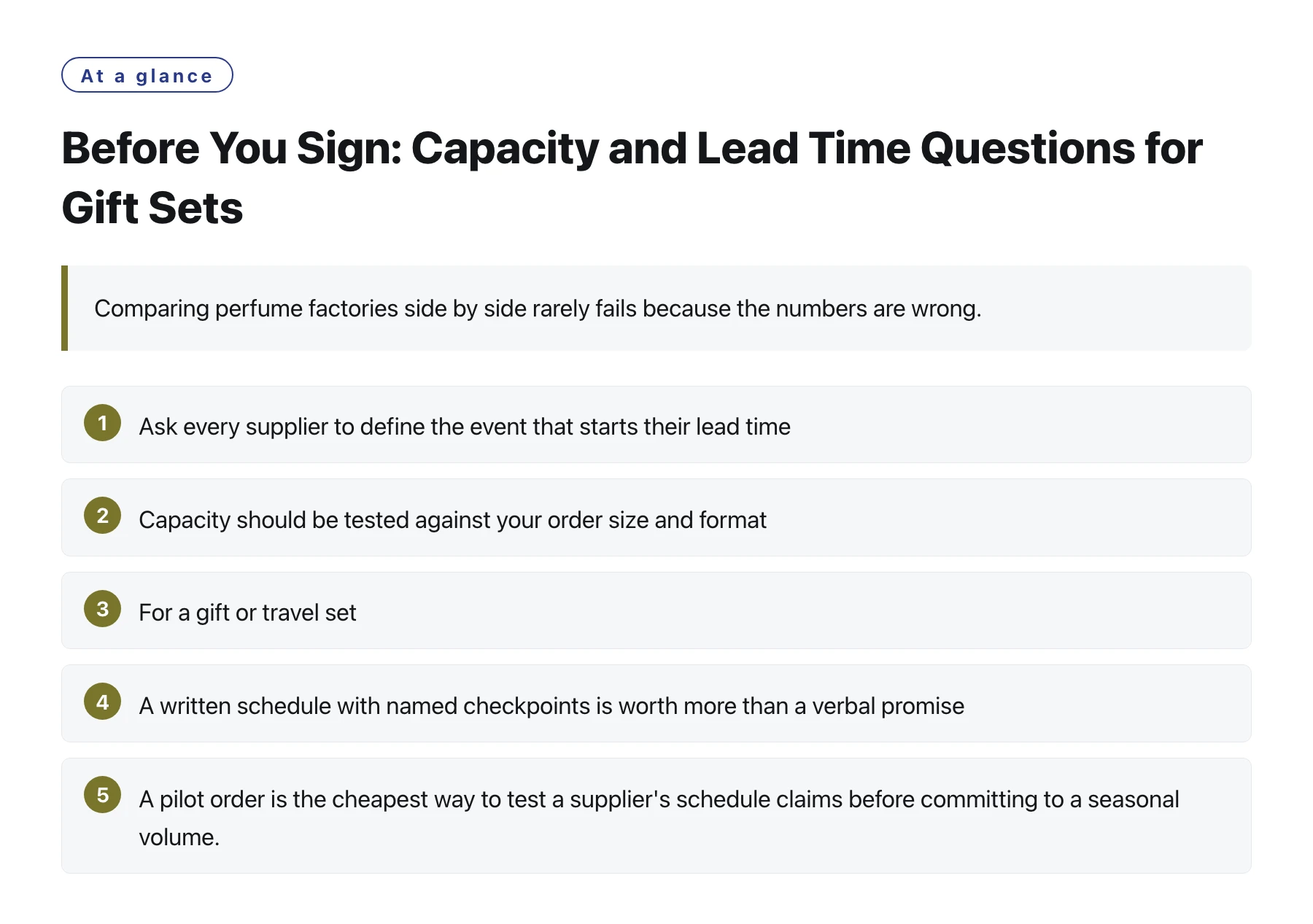
- Ask every supplier to define the event that starts their lead time, because a shorter number often just means a later starting point.
- Capacity should be tested against your order size and format, not against a headline figure for the factory as a whole.
- For a gift or travel set, the slowest input is usually a component or a decoration pass rather than the filling line.
- A written schedule with named checkpoints is worth more than a verbal promise, because it gives both sides a date to measure against.
- A pilot order is the cheapest way to test a supplier's schedule claims before committing to a seasonal volume.
Buyers usually enter a factory comparison with a single sheet of paper and a set of questions invented on the spot. The supplier that answers most confidently tends to win, which is a poor way to choose a production partner.
This is a fixed question list for a side-by-side comparison, organised around the two things that decide whether a launch date survives: capacity and lead time. Ask the same questions in the same order, in writing, and the comparison becomes a document rather than an impression.
What capacity actually means for your order
Capacity is not one number. A factory can have a large compounding capability and a small filling line, or the reverse, and a gift set touches several capabilities at once: compounding, filling, closure, decoration, assembly and packing. The relevant question is whether the specific combination your product needs is available in the week you need it.
Order size changes the answer. A run that is small in the factory's terms may still have to queue behind a larger customer, and a run that is large for the factory may be split across several weeks. Ask how your volume compares with a typical order, and where it would sit in the production plan.
Peak periods matter too. Seasonal demand compresses the calendar for everyone, and a supplier that knows its own busy window can tell you which weeks to avoid. Trade coverage of the household and personal products sector regularly follows capacity and supply pressure, which is a reminder that timing is an industry condition rather than a personal failing [1].
The four capacities that matter
Ask separately about compounding, filling, decoration and assembly. A factory may own three and subcontract one, and the subcontracted step is the one most likely to move. Knowing which it is tells you where to expect the delay. Suppliers that publish their scope, such as those describing fragrance manufacturing services in China, usually make this first question easy to ask.
Also ask whether the components your product needs are held in stock or ordered per project. Stock components shorten the schedule considerably; project-specific ones add a procurement stage that is outside the factory's direct control.
Why lead time needs a starting event
A lead time without a starting event is not a commitment. Suppliers quote from different points, and the difference can be weeks. Ask the question directly: does the clock start when the sample is approved, when the deposit clears, or when the last component arrives?
Then ask what happens if one of those events is late. A supplier that can describe the consequence has usually thought about the schedule; one that treats every delay as exceptional has not.
Questions worth asking in the same order
| Question | Why it matters | Weak answer | Strong answer |
|---|---|---|---|
| What starts the lead time? | Defines whether two quotes are comparable | A generic number of days | A named event and the assumptions behind it |
| What is the minimum per component? | Components, not the batch, often set the floor | A single order minimum | A per-part minimum, in writing |
| Which steps are subcontracted? | Shows where the schedule leaves the building | Everything is done in-house | A named step, a supplier type and who inspects it |
| How is your volume placed in the plan? | Reveals queue position and risk of splitting | We will prioritise you | A typical slot, a comparison to usual orders |
| What is the testing window? | Independent testing has a duration that cannot be rushed | Testing is quick | Which tests run when, and in parallel where possible [2] |
| What happens when a component is late? | Late components are the commonest cause of slippage | That will not happen | A described recovery plan with decision points |
Fill the two right-hand columns yourself during the conversation rather than trusting a summary written afterwards. The exact wording matters, because it is what you will refer to if the schedule comes under pressure.
How to run the comparison fairly
- Send the questions in advanceGive both suppliers the list before the meeting, so that answers are prepared rather than improvised and can be compared directly.
- Ask for written answersA written reply exposes gaps that a confident presentation tends to cover, and it creates a record you can hold the supplier to later.
- Score capacity and schedule separatelyA factory can be strong on one and weak on the other. Keeping the two assessments apart prevents a good filling capability from masking a weak component pipeline.
- Check the answers against a second sourceWhere a supplier names a subcontractor, a testing laboratory or a component type, the claim can usually be confirmed independently.
- Run a pilot orderA small first order tests the schedule claims at low cost, and the results are more informative than any further conversation.
- Put checkpoints in the contractAgree a small number of dated milestones, such as component arrival, bulk completion and inspection, so that slippage is visible while there is still time to react.
Reading the answers together
Once both sets of answers are on the page, the comparison usually becomes obvious. One supplier defines the lead time clearly and names the subcontracted step; the other gives a number and describes everything as straightforward. Neither answer is proof, but the first is testable and the second is not.
Pay attention to the questions a supplier asks you in return. Factories that are used to gift and travel projects tend to ask about fill weight, decoration and set assembly early, because those are the inputs that decide their own schedule.
Where a schedule usually breaks
Three failures account for most late gift sets: a component that arrives after the filling slot, artwork approved after printing was scheduled, and testing started later than planned because the sample was approved late. All three are coordination failures rather than production failures, which is why they are worth addressing in the contract rather than in conversation.
The defence is a short list of dated milestones and one named person on each side responsible for them. It does not need to be elaborate; it needs to exist before the pressure starts.
What to keep after the comparison
Keep the written answers, the final schedule, the reference standard and the inspection criteria together in one file. When a second order is placed, that file is what makes the repeat a reorder instead of a new project.
It is also worth recording what each supplier said it does not do. That list is useful when the product grows: a partner that cannot offer decoration in-house is not disqualified, but the limitation should be planned for.
Buyers comparing Chinese production options often start from a supplier's published account of capacity and process. Reading how production capacity and lead times are described, and then asking the factory to confirm each part with a date, is a practical way to use that material.
None of that replaces a pilot order. A first run of a small quantity, produced and inspected on the schedule you agreed, tells you more about a factory than any comparison sheet, and it does so before the season that matters.
Using published material as a reference point
Where you want a reference point for experience rather than throughput, the published record of past work is a reasonable input. brands Xuelei has manufactured for is the kind of page to read with the question list in hand, because it shows the sort of portfolio material a buyer can ask any supplier to provide.
The same applies to a company's own account of its history. a Chinese fragrance manufacturer since 1994 is the kind of description that can be checked against documents rather than accepted as a claim, and checking it costs one email.
Sign the schedule, not just the price. Three dated milestones, a named contact on each side and a written statement of what happens if a component is late will protect a launch better than any discount negotiated in the same meeting.
Sources
- Cosmetics & Toiletries —— A technical magazine for cosmetic formulators, covering ingredients, formulation science and testing methods.
- SGS: Cosmetics, Personal Care & Household Testing —— Testing, inspection and certification services for cosmetics and personal care, including microbiological, stability and safety testing aligned with cosmetics GMP.
Frequently asked questions
How do I compare lead times from two perfume factories?
Ask each one to state the event that starts the count and the assumptions behind the number. Only when both quotes begin from the same event do the figures become comparable, and often the difference turns out to be definitional.
Is a larger factory always faster?
No. A larger factory may have more capacity and a longer queue behind bigger customers. What matters is where your order sits in the plan and whether the specific steps your product needs are available in the week you need them.
What should I ask about minimum order quantities?
Ask per component rather than for the order as a whole. A set can meet the filling minimum while failing the minimum for a bottle, a cap or a printed box, and that detail is where small runs usually break.
Should I pay for a pilot order before a large run?
If the launch matters and the relationship is new, yes. A pilot produces real data on schedule, quality and communication at a fraction of the cost of a full order, and it is the cheapest available insurance.
How many checkpoints belong in the contract?
Three or four are usually enough to make slippage visible: component arrival, bulk completion, inspection and packing. More than that becomes administration that nobody maintains.